

Essential Spanish Family Vocabulary for Everyday Conversations
Learning how to talk about your loved ones is a fundamental step for any language learner. Whether you are introducing your siblings or explaining your family tree to a new friend, mastering Spanish family vocabulary is essential for everyday conversations. In this guide, we will break down the most common terms for immediate and extended family members, from padre to bisabuelo, and provide you with an interactive quiz at the end to help you memorize them quickly and effectively.
Key Spanish Family Terms and Gender Rules
To build a solid foundation, let’s start with the people you likely interact with the most. In Spanish, nouns have gender, so you will notice that many words change their ending from -o (masculine) to -a (feminine).
Immediate Family (La Familia Cercana)
These are the core members of a household. Mastering these is your first priority:
- Padre – Father
- Madre – Mother
- Padres – Parents (also means “fathers”)
- Hijo – Son
- Hija – Daughter
- Hermano – Brother
- Hermana – Sister
- Esposo / Marido – Husband
- Esposa / Mujer – Wife
Extended Family (La Familia Extendida)
Once you have the basics down, you can start describing your cousins, uncles, and grandparents:
- Abuelo – Grandfather
- Abuela – Grandmother
- Nieto – Grandson
- Nieta – Granddaughter
- Tío – Uncle
- Tía – Aunt
- Primo / Prima – Cousin
- Sobrino – Nephew
- Sobrina – Niece
The In-Laws (La Familia Política)
In Spanish culture, extended family is very important. To talk about your “in-laws,” we use specific terms rather than just adding “in-law” to the end:
- Suegro / Suegra – Father-in-law / Mother-in-law
- Yerno – Son-in-law
- Nuera – Daughter-in-law
- Cuñado / Cuñada – Brother-in-law / Sister-in-law
Pro-Tip: The Plural Rule
In Spanish, when you have a group of mixed genders (e.g., one brother and one sister), you use the masculine plural form. For example:
Mis hermanos = My brothers OR my brother(s) and sister(s).
Family ties in Spain and Latin America have traditionally been very important and continue to play a central role in social and cultural life. Although there have been changes in recent decades due to modernization and socioeconomic changes, the family remains a fundamental pillar of society.
Here is a complete overview of parental nomenclature in Spanish (including in-laws).
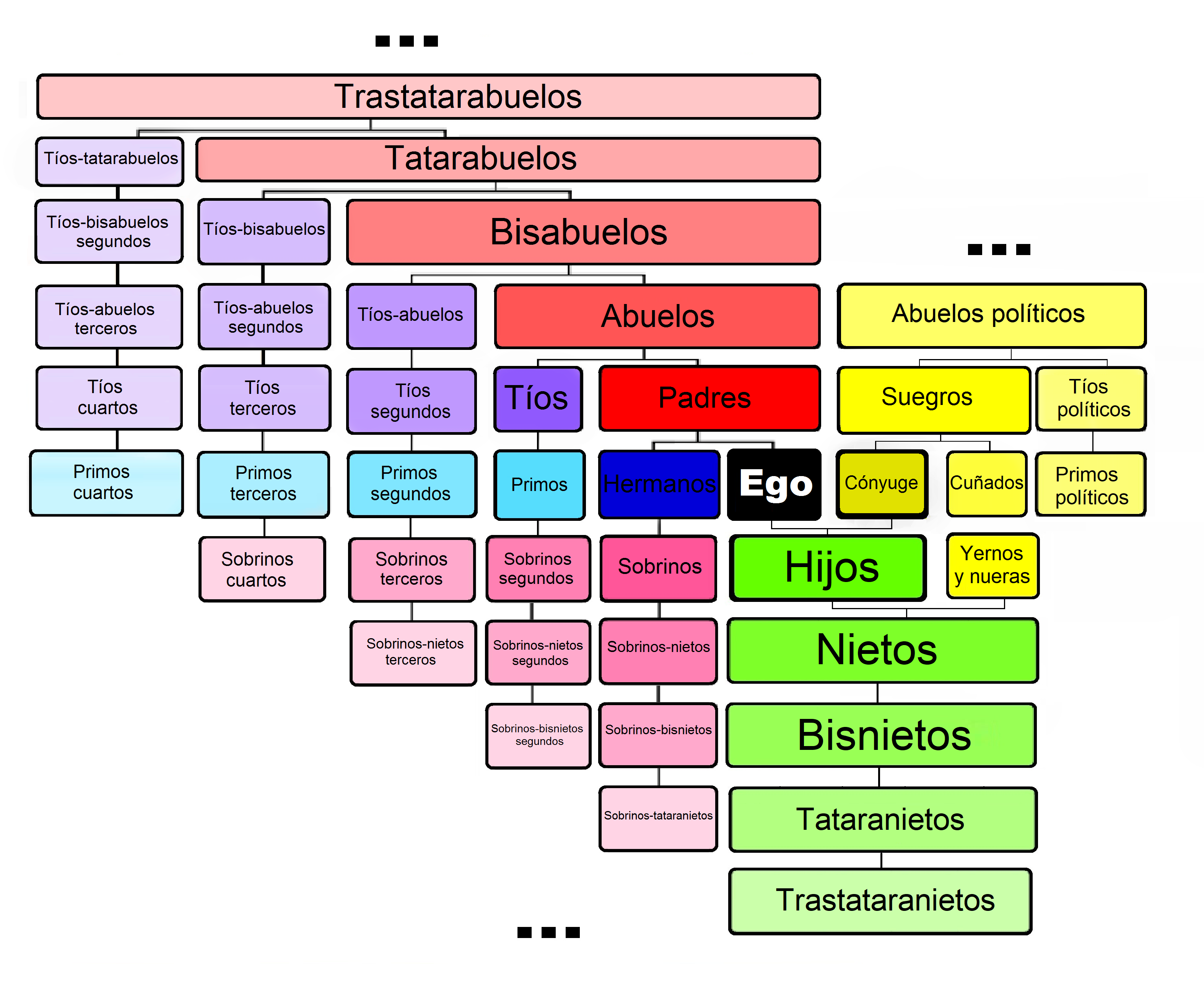
Spanish Exercise
Here is a very useful quiz for learning and memorizing Spanish family vocabulary. You must complete the sentence with the missing word.
You can use the letters to complete the sentence from your cell phone. If you are using a computer to do the exercise, you can also type with the keyboard.
✏️ You can also practice…
Ejercicio de vocabulario – Frutos secos

¿Te gusta practiquemos.com?
Dame 5 estrellas. Me ayudas mucho 🙏
Give me a 5-star rating
¡Muchas gracias!
★★★★★
¿Tienes alguna pregunta o algún comentario?
Haz clic aquí para dejar un comentario
Me encanta saber tu opinión ❤︎


